
Impact

A Father’s Example
Arthur Gebhardt’s legacy lives in his canvases, the lives he touched, and the people who carry his example forward. He was a businessman who made time for art, a father of seven who modeled persistence and humility, and a community member who gave generously without seeking recognition. His impact runs through family, friendships, and the broader Milwaukee community.
He believed that a meaningful life was created through the work of one’s hands and the valuable relationships one honored. “Just as a father might do, he came to me, and said, ‘What would you like to do with your life?’ and I told him ‘I’d like to run a small business.’ He found one, and he and I bought it and Sarah and I ran it for 37 years. We recently sold it and retired. If he hadn’t been that leading force for me, I’m not sure what I would have done with my life.”
It wasn’t only his vision that left a mark, but his capacity for connection. “He understood the value of relationships. After my mom died, he had a legal yellow pad and he would write down all the people he wanted to see—friends, acquaintances, or people he’d just met. He would get on the phone and start at the top of the list, and call, and if the person said no or couldn’t do it, he’d go to the next one. He figured out that in retirement you need those connections to people. He said, ‘I don’t care if they say no.’ That was one of those habits he had.”
His faith sustained that impulse to connect. “My most memorable and deepest conversations with my father were not about art, they were about spirituality and God. I know that my dad brought me to God and I do know that is a role that he played in my life. We would go to mass in the mornings before he took me to high school, and I remember when I turned 18 for Christmas I got a book by the Trappist monk Thomas Merton—No Man is An Island. I still have that book.”
Guiding by Example
He believed in courage through creation. “He helped me. I remember I did a painting of a window in a Catholic church in Dallas. I started it on computer paper because I was afraid to paint it. He said, ‘Oh my god, just do it.’ The window had a funny shape. So, he gave me a book by Georges Rouault, who as a painter uses a lot of thick, black lines. I finished the watercolor on computer paper because he said just do it and said this is what you do when you draw the lines on the window. I was so concerned about the shape of that window, and he pushed me past my fear.”
That same encouragement guided how he lived and gave. “My dad was very humble throughout his whole life with everything he did. He gave generously to organizations and schools to help people, but he didn’t want his name on anything, he just wanted to do things and not to be recognized. He was very helpful to many, which I really admired in him. He taught me to be a volunteer. He said, ‘Mary, if you’re unhappy or ever want to get out of something, you’ve got to go help somebody. That was his motto—both my parents were that way.”
He lived by example. “He always had high standards for us and a lot were unspoken. He wanted you to be upstanding—he’d say don’t slack off, do what is expected of you, and life will go well for you. I don’t know why but we all knew we had to have a job. We got a clothing allowance once or twice a year for about $100. It had to pay for everything we needed in our lives; underwear, boots, etc. If you wanted something extra you had to work for it. It didn’t feel punitive; it was just one of the things he passed on to us. It made you feel good because you did work hard and we all had jobs very early. I remember I got my work permit at 14. It was applauded in our family if you had a job.”


The Long Arc of a Creative Life
To the end, his work remained his companion.
“He was always so dedicated to his work. He would talk about being 93 and then 94—he could have been my father. We all struggle to find time to make work and to keep ourselves interested. We all come up with things we are interested in, but you’ve got to really love something to do it your entire life, especially as you get older and you’re accompanying that with the pain and loss of things in your family and aging itself. Then there’s the relationship with family, spouses, kids, and neighbors but you have to have a relationship with your work, and Art maintained that balance because he loved the work. That was so inspiring to me.”
He mentored younger artists and craftspeople, and offered his work freely believing in art as a gift rather than a commodity. Exhibitions at local museums and universities positioned him among other respected regional artists, yet he remained fiercely humble, often insisting he was “still learning.”
“…if you’re unhappy or ever want to get out of something, you’ve got to go help somebody. That was his motto—both my parents were that way.”
Featured Artwork
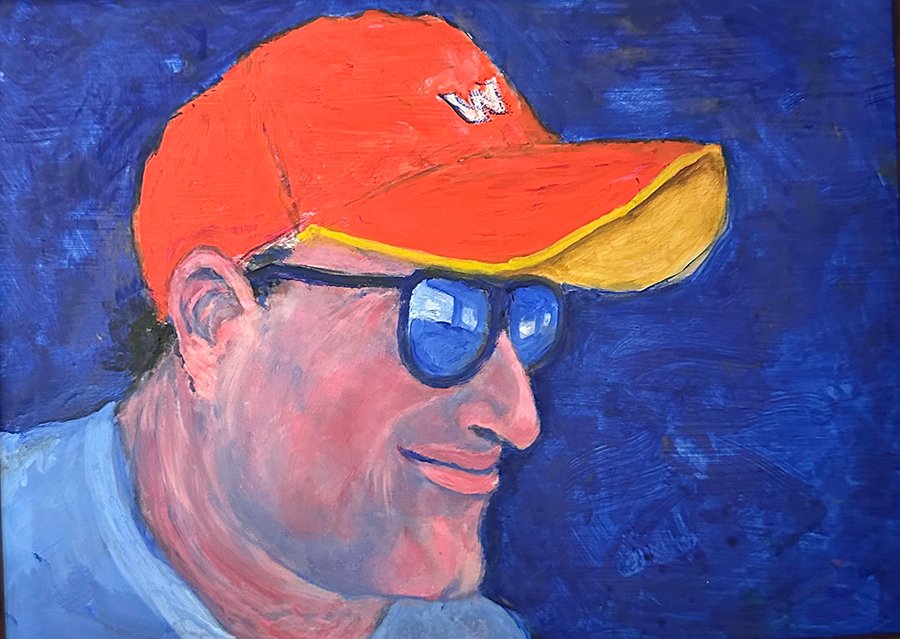
Self Portrait
Oil
This self-portrait shows Gebhardt as subject and witness—a painter taking his own measure. He did a number of self-portraits over time and, not surprisingly, was often honest and straightforward in his own portrayal.
